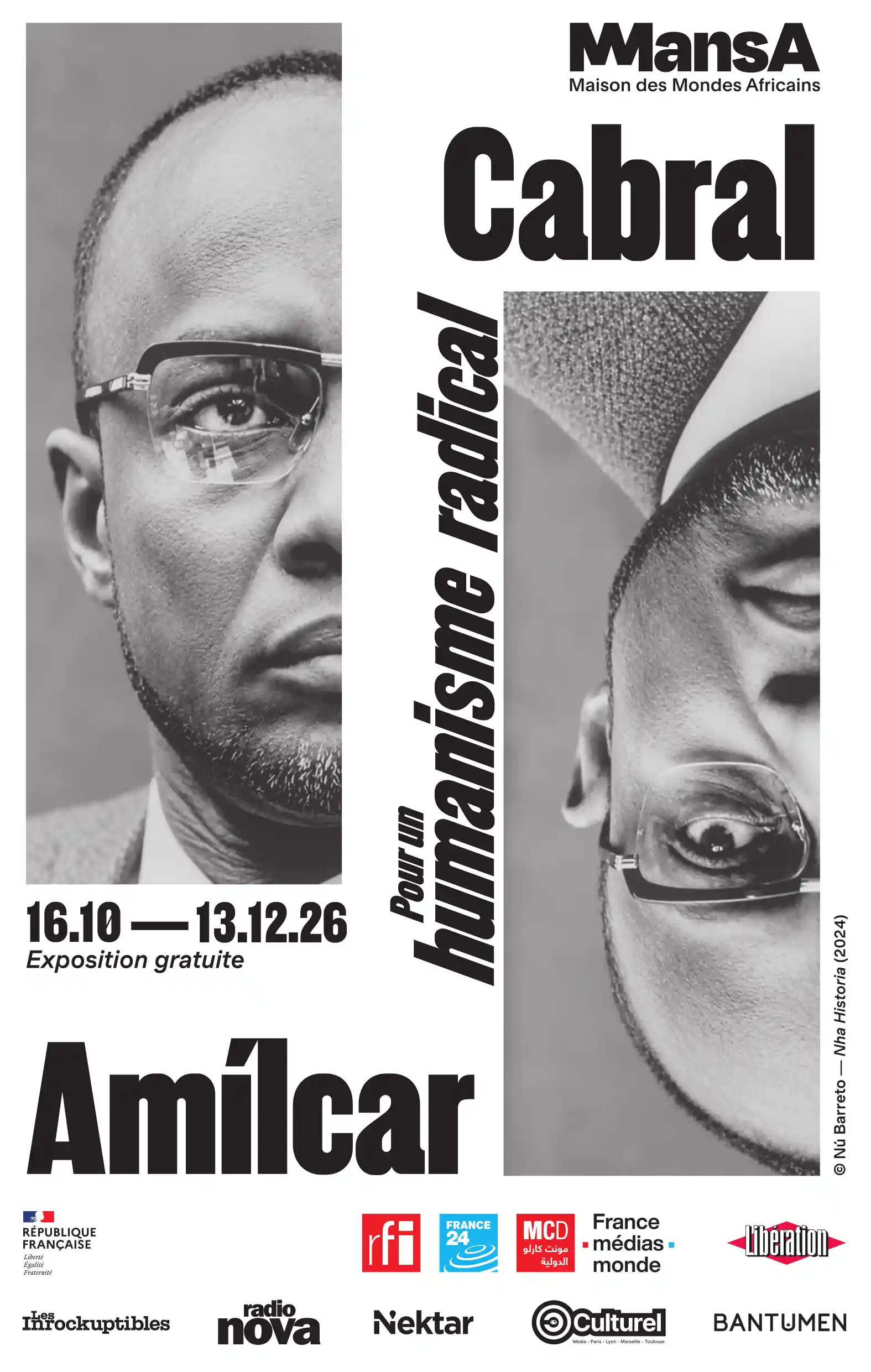
From October 16 to December 13, 2026, MansA is dedicating an exhibition to Amílcar Cabral (1924–1973), a revolutionary, theorist, agricultural engineer, and leading figure in the African independence movements. Curated by Armelle Dakouo and Ângela Benoliel Coutinho, based on an original concept by Paula Nascimento, *Amílcar Cabral: Toward a Radical Humanism* creates a dialogue between his ideas and contemporary art through the works of nine artists from Portuguese-speaking Africa and beyond.
What else does Cabral have to say to us today?
More than fifty years after his assassination, Amílcar Cabral’s ideas continue to inform discussions on sovereignty, global inequalities, population displacement, and ecological crises. His approach—understanding the world in order to better transform it—and his conception of culture as a force for emancipation continue to provide tools for reflecting on the connections between culture, power, and freedom.
For Cabral, national liberation is not limited to the achievement of political independence: it entails a profound transformation of societies, cultures, and consciousness. The land, art, and culture are not on the periphery of the political struggle, but at the very heart of building a new society.
The exhibition explores the continued relevance of Cabral’s ideas by contrasting them with the perspectives of contemporary artists.
A Philosophy in Dialogue with Contemporary Art
The works of Nú Barreto, Diogo Bento, Filipa César, Monica de Miranda, Bento Oliveira, Hamedine Kane, Yuran Henrique, Sónia Vaz Borges, and Sarah Maldoror together form a living geography of what Cabral called *a luta* —the struggle.
Bringing together artists from Guinea-Bissau, Cape Verde, Senegal, and Portugal, the exhibition creates a dialogue between textiles, photography, installation, video, and drawing, exploring concepts central to Cabral’s thought: identity, nation, belonging, and cultural resistance.
Here, contemporary practices intersect with archives and cultural legacies. The films of Sarah Maldoror—a pioneering filmmaker and a committed figure in liberation struggles—play a particularly foundational role in the exhibition. *Fogo, Île de Feu*, *Carnaval dans le Sahel*, and *A Bissau, Le Carnaval* further explore the theme of culture as a space for reappropriation, memory, and resistance.
Through their artistic visions, the nine invited artists do not seek to illustrate Cabral’s ideas but rather to engage in a dialogue with them, to expand on the questions they raise, or to reinvent their perspectives.
The exhibition thus invites us to view Cabral not only as a major figure in African liberation struggles, but also as a body of thought to be brought back into circulation, confronted with the present, and engaged in dialogue with the creative works of our time.
A soundtrack curated by Rocé
To complement the exhibition, MansA enlisted rapper and producer Rocé to create the exhibition’s soundtrack.
This musical selection does not seek to recount Cabral’s life in chronological order. Instead, it highlights the echoes of his ideas in the music of struggle, revolutionary songs, and compositions that accompanied the struggles for African emancipation and independence.
From Guinea-Bissau to Cape Verde, from Angola to Mozambique, the soundtrack brings together iconic works, archival recordings, and rarer recordings. Some pieces were rediscovered in old editions and then digitized so they could be heard once again. Music thus becomes both an experience of the journey and a means of transmitting a sound heritage that is sometimes poorly documented.
An artist and music researcher, Rocé has long been interested in the music that accompanies movements for emancipation and in cultural exchanges between Africa and its diasporas. His work—which involves researching, unearthing, and promoting rare and socially conscious African and Afro-diasporic repertoires—takes on a new form here within the exhibition space.
This journey also underscores the importance Cabral attached to culture in the process of emancipation: not merely as a reflection of history, but as one of its driving forces.
About the Exhibition
In conjunction with the exhibition, MansA is presenting a multidisciplinary program of talks, discussions, film screenings, music, and audio presentations to further explore the ideas of Amílcar Cabral and his legacy.
THE EXHIBITION
October 16 → December 13, 2026
Amílcar Cabral: In Support of a Radical Humanism
Wednesday through Sunday · 2:00 p.m.–7:00 p.m.
Last admission at 6:15 p.m.
Free admission with reservation
GUIDED TOURS
Saturday, October 17 · 2:30 p.m. & 4:00 p.m.
With curators Armelle Dakouo and Ângela Benoliel Coutinho.
Free admission with reservation.
RELATED EVENTS
October → December 2026
October
October 22 · 7:30–9:00 p.m.
→ To Defend the Earth is to Defend Humanity: Cabral, a Pioneer of Regenerative Agriculture?
A conversation with Carlos Lopes · moderated by Ousmane N’Diaye
October 27 · 8:00 p.m.
→ Concerning Violence
CinéMansA at the Nouvel Odéon · Göran Hugo Olsson
October 28 · 2:00 p.m.
→ À ma Gloria
CinéMansA Family Movie Night at the Nouvel Odéon · Ages 8 and up
October 29 · 7:30–9:00 p.m.
→ Amílcar Cabral and Culture as a Tool for Liberation
A discussion with Firoze Manji, Maria-Benedita Basto, and Valérie Nivelon
November
November 3 · 7:30–9:30 p.m.
→ MansA Radio — Listening session for the Super Papa Djombo podcast
With Jérémi Nureni Banafunzi and Malan Mané
November 5 · 7:30–9:00 p.m.
→ Feminisms in Africa’s Liberation Struggles: What Connections to Today’s Struggles?
With Ricci Shryock, Isabel Casimiro, and Christelle Bakima Poundza · moderated by Ângela Benoliel Coutinho
November 9 · 8:00 p.m.
→ Resonance Spiral
CinéMansA at the Nouvel Odéon · Marinho de Pina and Filipa César
November 19 · 7:30–9:00 p.m.
Sound Vigil — Mystery Lineup
An evening dedicated to morna and coladeira. The artist’s identity will be revealed shortly.
November 26,
→ Debate on Current Events in Cape Verde
In connection with the 2026 presidential election
December
December 3 · 7:30–9:00 p.m.
→ Tina: A Musical Legacy of the Women of Guinea-Bissau
With Daniela da Fonseca Gomes Nazaré
December 7 · 8:00 p.m.
→ Cuba, an African Odyssey
CinéMansA at the Nouvel Odéon · Jihan El-Tahri
December 13,
Closing event for the exhibition “
”
Live performance by Tina, featuring traditional music from the women of Guinea-Bissau
THROUGHOUT THE JOURNEY
The works and exhibition spaces are accompanied by a soundtrack created by Rocé, conceived as a journey through the music of resistance and the sonic legacies associated with African independence movements.
