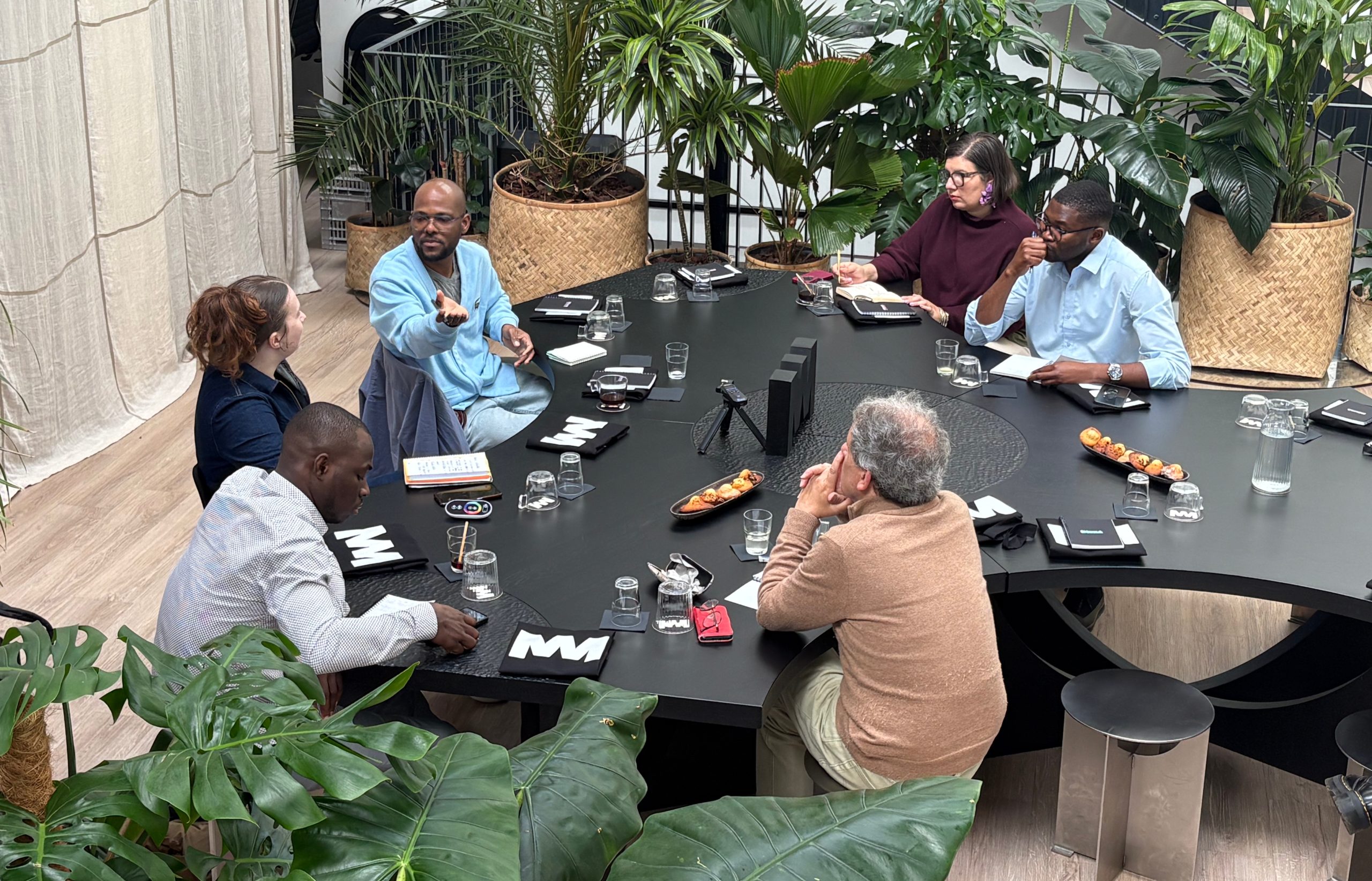
At the third MansA Research Breakfast, held on May 7, 2026, sociohistorian Brice Molo will offer reflections on catastrophe as a form of power in postcolonial societies. Taking Frantz Fanon as his starting point, he examines the transformation of the colonial “hand-to-hand struggle” into a confrontation between the postcolonial state and society, centered on the unfulfilled promises of decolonization and the unevenly distributed benefits of modernity.
By Brice Molo
Published on May 19, 2026
What is a catastrophe, and what is power in postcolonial society? To answer these two questions, this paper proposed taking Frantz Fanon as a starting point for thinking beyond him.
In *The Wretched of the Earth*, Fanon describes the colonial scene as an ongoing trial between the colonized and the colonizer. In this trial, each party enters “with their blackness or their whiteness.” This physicality is both the very essence of politics in the colony and the instrument of a form of governmentality—to borrow Foucault’s term—insofar as it shapes the behavior of the governed.
With the end of colonization, the departure of the “father” brings an end to his conflict with the “son” and gives rise to a new configuration in which, from now on, “brother is pitted against brother,” to quote Achille Mbembe. As the racial distinction that structured the colonial struggle formally faded with decolonization, the colonized ceased to be an object of power and became a subject of power; in other words, a citizen, a priori the holder of rights framed by the promise of equality and protection upheld by the postcolonial state.
But precisely because this promise is often betrayed, the structure of the face-to-face relationship transforms rather than disappears. It is no longer the racial conflict of the colonial era that pits the state against society, but the fact that decolonization has failed to deliver on its promises. This transformation marks the advent of what I call a “society of catastrophe,” which also sees the emergence of a post-governmentality that goes beyond Foucault’s “discipline of disciplines” to become “misbehaviors of misbehaviors.” Indeed, the state’s inability to fulfill the promise of decolonization is regarded as a form of misconduct and, in turn, gives rise to derivative forms of misconduct on the part of citizens. The example of the fire in Nsam, Yaoundé, on February 14, 1998, and the train derailment in Éséka in 2016 are situations that illustrate this concept. It is here that the postcolonial scene of the catastrophe closes in on Fanon and transcends him. In the society of catastrophe, the head-to-head struggle pits the state—a colonial legacy—against society, centered on control of resources and the consequences of modernity. Catastrophe is the visible and climactic form of this ongoing confrontation.
In this sense, behind every postcolonial catastrophe there is, inevitably, a breach of conduct and a direct confrontation. The catastrophe is a trial of the postcolonial state; it initiates and sanctions a showdown that forces all actors to renegotiate their claims to the resources of modernity and to power itself.
¶ Brice Molo holds a Ph.D. in sociology from EHESS and a Ph.D. in history from the University of Yaoundé I. After completing his dissertation, he began a postdoctoral fellowship at the IRD’s Ceped (PC RISC – Irima). He is currently an associate professor at the ICP (FASSED, Department of Sociology), where he teaches the sociology of risk and the history of ecological thought, among other subjects. He is a member of the executive committee of the French Sociological Association.
Bibliography
Frantz Fanon, *The Wretched of the Earth*, Paris : La Découverte, 2002.
Michel Foucault, “Preface to The History of Sexuality,” *Dits et écrits*. Volume IV. 1980–
–1988, Paris : Gallimard, 1994, pp. 578–584.
Achille Mbembe, *On the Postcolony: An Essay on Political Imagination in Contemporary Africa*, Paris: Karthala, 2000.
Molo Brice, “The Society of Catastrophe: Rethinking Power After the Colonial Society of Risk: A Postcolonial Theory,” *Comparative Political Societies*, 66, 2026, pp. 79–102.
