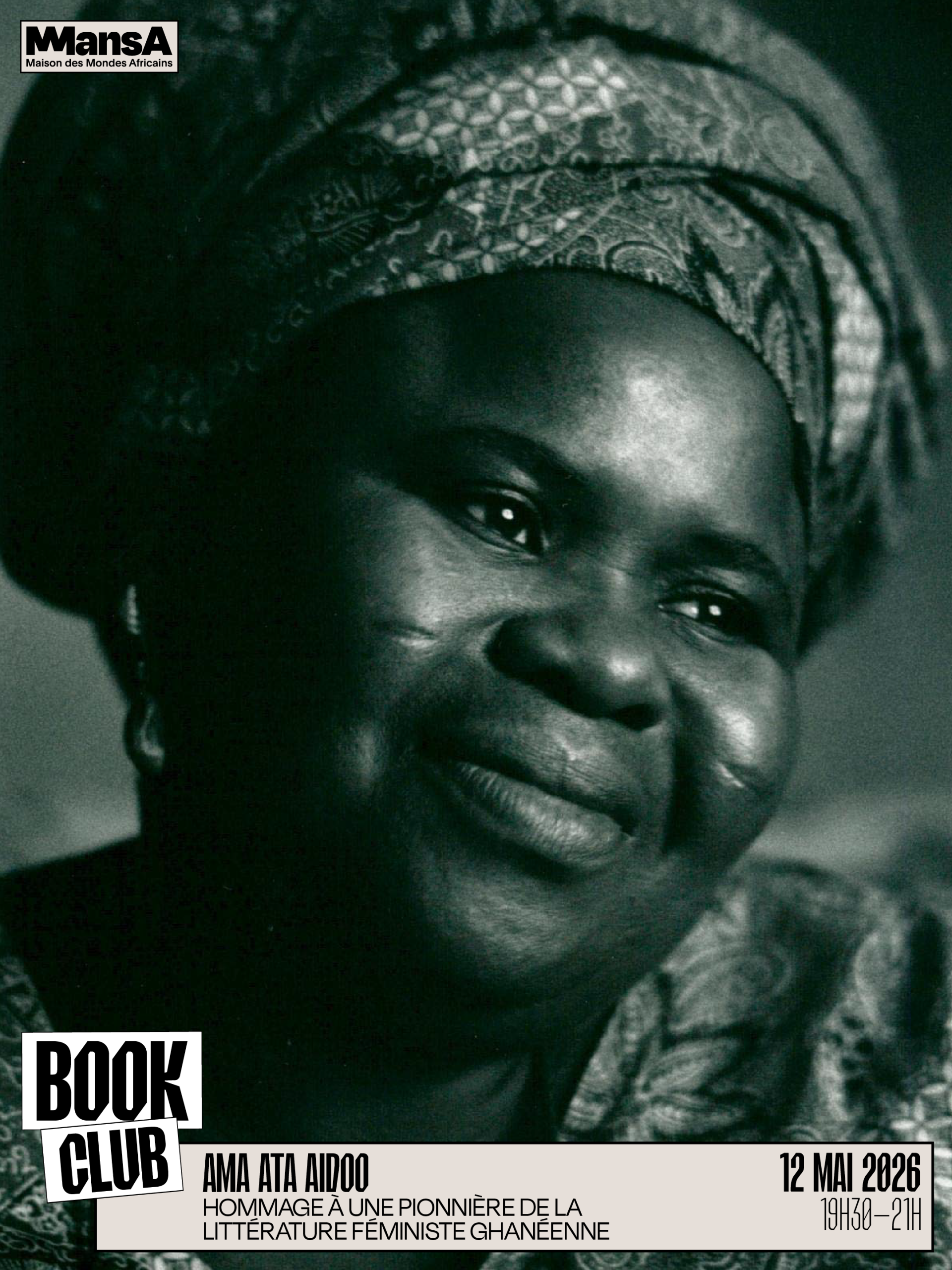
To mark the French publication of *Our Sister, the Killjoy*, MansA is hosting an event dedicated to this seminal work of African feminist literature. Blending satire, poetry, and postcolonial criticism, Ama Ata Aidoo offers a incisive look at the relationship between Africa and the West through the journey of a young woman in search of clarity.
Sissie, a young student in Ghana during the early years of independence, wins a scholarship to study in Europe. The journey that takes her from Germany to England reveals to her just how much the relationships between Africans and the West—and Africans’ relationships with themselves—remain shaped by coloniality.
In this essential work of African feminist literature, finally translated into French, everything revolves around a shift in perspective and reference points. Here, the skeptical decolonized woman observes her former colonizers. Carefully woven from prose and free verse, this funny and scathing novel by Ama Ata Aidoo opens up the thoughts of a Black woman venturing into the heart of whiteness.
*Our Spoilsport Sister* is the debut novel by the Ghanaian writer Ama Ata Aidoo, originally written in 1966 and published in 1977 in London. A seminal work of feminist and women’s literary experimentation on the continent, this novel stands out as a must-read thanks to the strength of its feminist and anti-colonialist commitment, combined with the power of its writing. Fifty years after its first publication, it retains all its freshness and original power. So while Ama Ata Aidoo remains largely unknown in the French-speaking world, this translation aims to remedy that.
Ama Ata Aidoo (1942–2023) was a Ghanaian author and playwright whose prolific body of work—including novels, poetry, short stories, plays, and essays—explored postcolonial challenges and the condition of African women. She had a long career as a university professor (in Ghana, Kenya, Zimbabwe, and the United States) and fought throughout her life for access to education and writing opportunities for Black women, drawing on her political activism and the advocacy organizations she founded.
SPEAKERS
Mame-Fatou Niang – Professor of French Literature and Founding Director of the Center for European and Atlantic Black Studies at Carnegie Mellon University (Pittsburgh). Her research focuses on Black geographies, Blackness in France, and the institutionalization of Black studies. She is also the international curator of the Rio de Janeiro Literary Festival and an artist-in-residence at the Ateliers Médicis in Paris. She co-directed *Mariannes Noires: Mosaïques Afropéennes* (2015) and published the essay *Universalisme* (Anamosa, 2022).
Patricia Houéfa Grange – Poet, translator, and voice artist. Born in Cotonou, her work draws on her diverse heritage spanning Benin, Cape Verde, and France. Her work explores issues of multiculturalism, transmission, and physicality, with a particular focus on women’s experiences and struggles. She is a co-translator of *Notre Sœur Rabat-Joie*.
Guillaume Cingal – Associate Professor of English-language and postcolonial literature, translation, and translation studies at the University of Tours. A specialist in the literature of English-speaking Africa and postcolonial studies, he is also a translator of historical essays and a literary critic. He contributes regularly to journals and has participated in the Assises de la traduction littéraire. He is the co-translator of Our Sister, the Joy-Killer.
Sacha Shiro (moderator) – A member of the editorial team at Ròt-Bò-Krik, she is pursuing a master’s degree in Humanities/Literature at the Sorbonne Nouvelle, specializing in gender, postcolonial, and subaltern studies.
