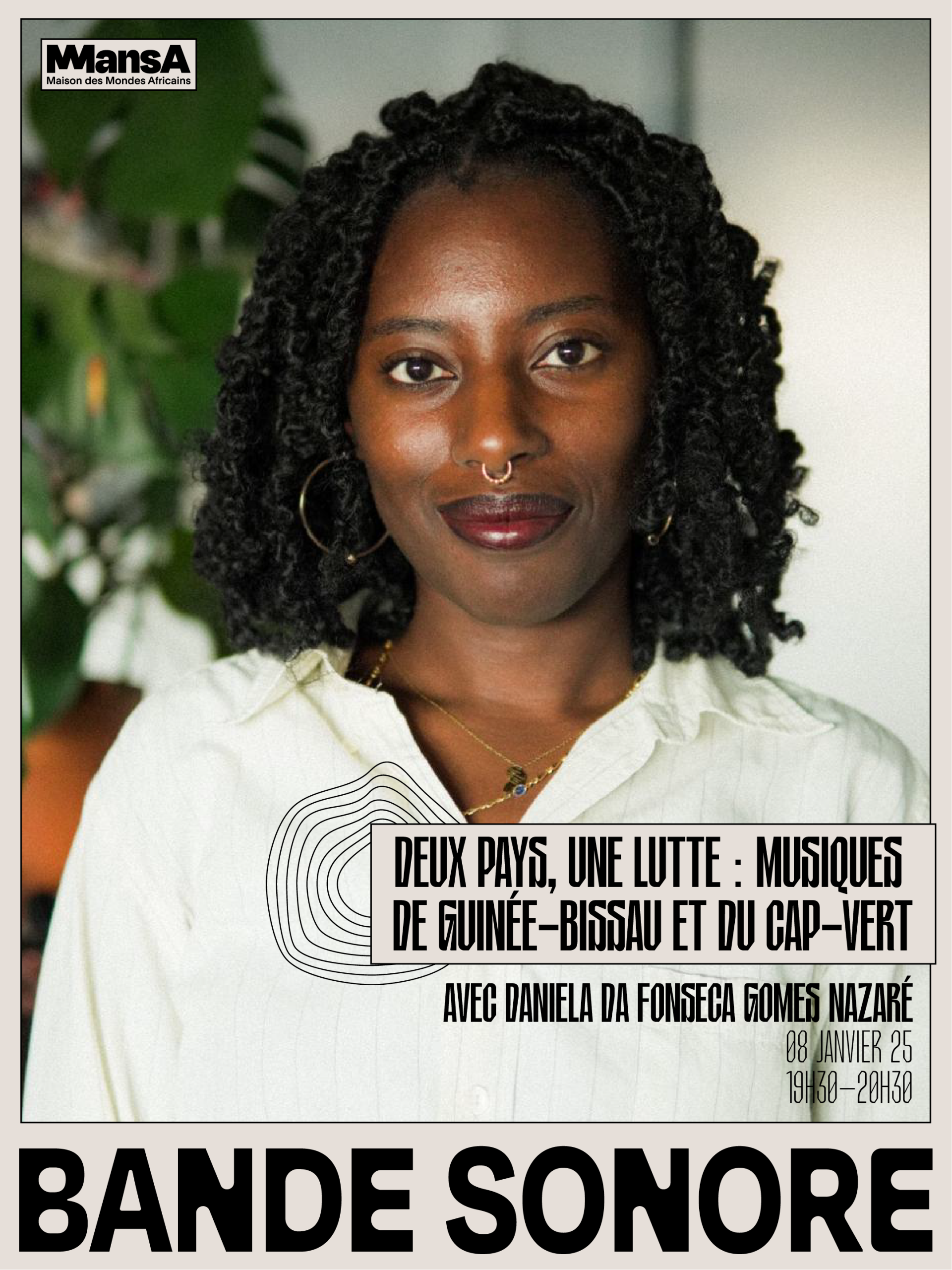
On Thursday, January 8, MansA welcomes Daniela Da Fonseca Gomes Nazaré, music journalist and cultural curator, for an exploration of the distinct musical identities of Guinea-Bissau and Cape Verde, born out of a shared struggle for independence.
How did Guinea-Bissau and Cape Verde, long united in the struggle for independence, nevertheless develop distinct musical identities? Colonized by Portugal in the 15th century and administered jointly for many years, the two countries forged a shared political memory. United in their struggle for independence, and even pursuing a project of unification, they nevertheless separated in the 1980s. But Cape Verdean and Bissau-Guinean music still resonates today with echoes of this history of liberation.
For this fourth soundtrack, MansA invites you to listen to excerpts from the 70s, 80s, and 90s to understand its foundations, as well as more contemporary tracks. While the first artists celebrated the struggle, today's creations reveal how this legacy is being revived—largely thanks to diasporas, which provide a link between the past and the present.
Morna, coladeira, gumbé, funaná: what stories do these genres, which have stood the test of time, tell? To what extent do they embody nostalgia, renewal, and resistance? What place do Portuguese and the Creole languages of Cape Verde and Guinea-Bissau occupy in these repertoires? And what role have women played in the internationalization of this music? MansA invites you to explore these questions during this session.
Music journalist and cultural curator Daniela Da Fonseca Gomes Nazaré navigates between African and Afro-descendant music, with a particular interest in West Africa and the Afro-Portuguese-speaking world. With a background spanning Portugal and France, she contributes to the media outlet Le Type and founded OKINKA, a Bordeaux-based platform dedicated to these types of music. OKINKA is incubated at MansA Lab, MansA's cultural incubator, to support its development and increase its visibility.
