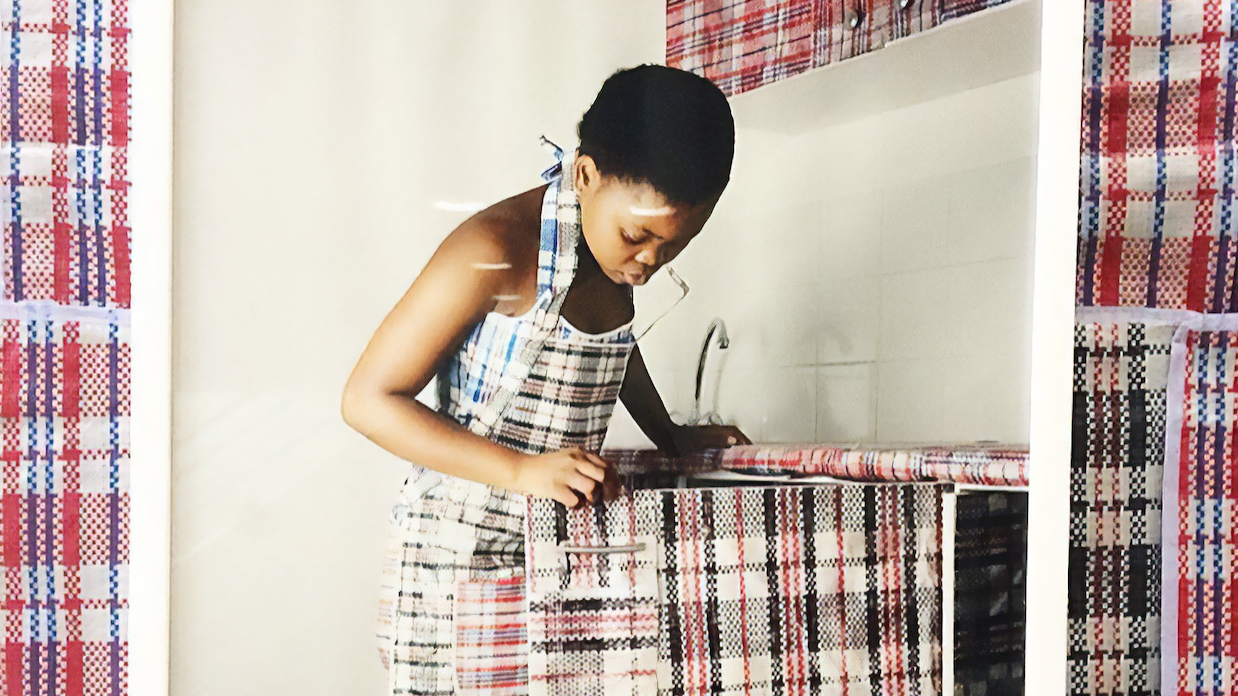
What do our clothes, our gestures, and the sartorial habits we pass down—without always documenting them—tell us? As part of the first cohort of MansA Lab, Eniola Telly explores the connections between fashion, memory, and transmission. With *À la mode de chez nous*, she documents African and diaspora sartorial practices—drawing on research, archives, and everyday narratives—to bring to light alternative histories of fashion.
By Selma Chougar
Published on May 28, 2026
In Eniola Telly’s childhood memories, it all begins amid the colorful bustle of Abidjan’s markets. In Treichville, amid the fabric stalls and trips back and forth to her aunt’s sewing workshop, fashion isn’t an abstraction but an everyday, almost vital part of life. “We grow up with this idea of dressing up, of marking special moments,” she says. Baptisms, weddings, Sundays at church: each occasion dictates its own attire, fabrics, and customs.
Trained at the Institut Français de la Mode and having worked in brand content and visual production, Eniola Telly initially followed a traditional career path. Yet something was missing. In the narratives she was taught, there were few traces of the stories that had shaped her. “I loved what I was learning, but I didn’t quite see myself in it,” she confides. So she looked elsewhere, writing and documenting. Her memoirs became a field of exploration: from wax fabric and its political dimensions to a genealogy of styles in Abidjan since independence.
This research gave rise to *À la mode de chez nous*, first as a thesis title, then as a project. More than just a platform, it envisions a hybrid space at the intersection of research, creation, and transmission. An “observatory” that focuses less on the runway and more on the invisible gestures—those of itinerant tailors, sartorial habits, and everyday practices that we inherit and that elude official archives.
Because that is precisely where her ambition lies: to shift our perspective. “Many practices exist but aren’t documented as part of fashion,” she explains. By grounding her work in the personal and the everyday, she aims to produce new material that can inspire designers, institutions, and schools. It’s also a way to reconcile heritage and contemporary culture, the homeland and the diaspora, without pitting them against one another.
Still in its launch phase, the project is gradually taking shape, led from Paris but conceived across multiple regions. Ultimately, Eniola Telly envisions a structure capable of forging connections, like a web stretching across territories and narratives.
The MansA incubator supports this process: “It helps me organize my thoughts and take the time to define things,” she explains. This is precious time for transforming an intuition into a method and a personal memory into a collective project. It’s also a space for exchange: “Within the cohort, projects build on one another, perspectives broaden, and connections are forged,” she explains implicitly. It’s a way of laying the groundwork today for what will become a network tomorrow.
