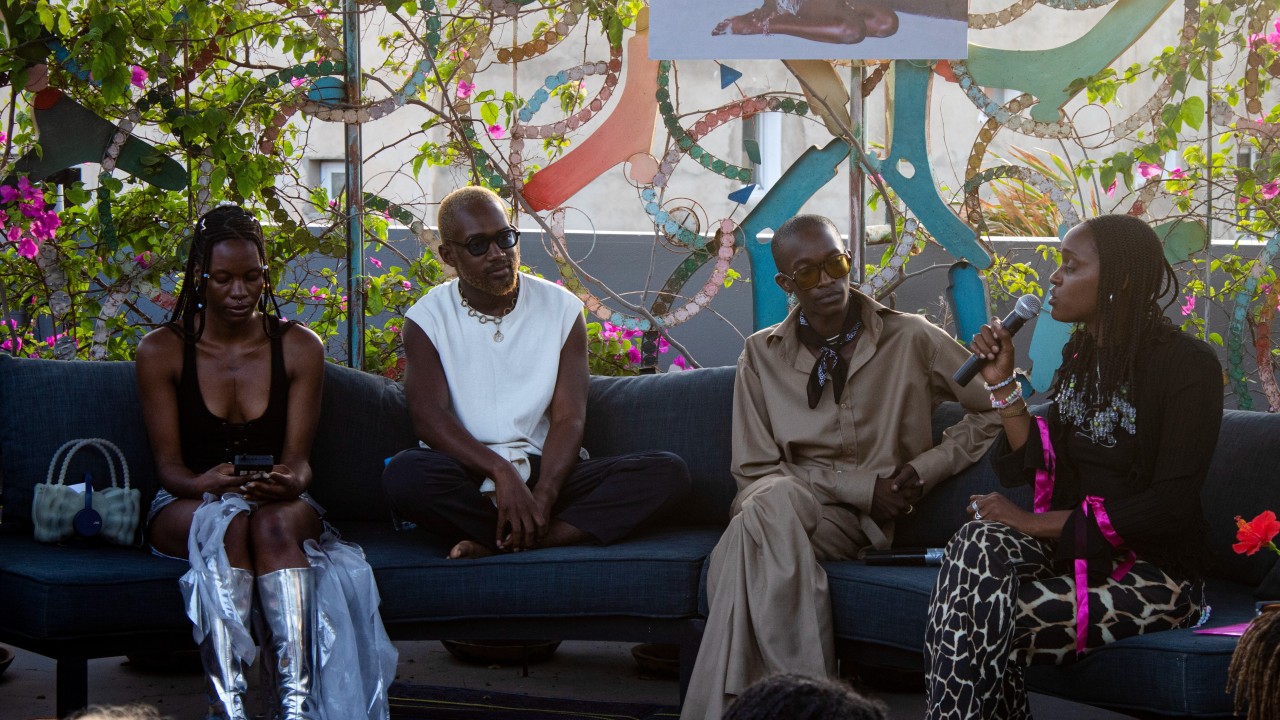
Koura-Rosy Kane joins the first cohort of MansA Lab with Platform, a creative lab and magazine dedicated to emerging and alternative fashion. The project aims to support emerging talents—particularly those of African descent—and provide them with spaces to experiment, showcase their work, and take control of their own narratives.
By Selma Chougar
Published on December 18, 2025
As a child, Koura-Rosy Kane realized she didn’t blend in easily. Growing up between Lyon and a small town in the Ain department, often as one of the few Black students, shaped a particular sensibility: that of learning to find her place in an environment where she sometimes felt out of step. “I ended up internalizing the rejection,” she confides. Straightening her hair, getting weaves, trying to adjust her image to meet others’ expectations. Looking back, she sees this as a driving force: “Without those experiences, I wouldn’t have had the determination to change the way people talk about us.”
Today, that determination has a name: PLATFORM, a creative lab, research space, and magazine dedicated to Afro-communities, founded in 2018. A spiderweb with many branches—creative strategy, ethnography, curation, imagery, writing—but with a single core mission: to set the record straight.
Before PLATFORM, Koura-Rosy was exploring her path. She earned a master’s degree in communication, took a detour into sociology, and then spent time in London, Amsterdam, and Dakar. Everywhere she went, she observed. Dakar, in particular—where she lived for several years—became a deeply personal field of study. There, she mapped out the creative industries, scoured secondhand markets overflowing with Western textile waste, and documented emerging designers. “Ethnography guided the entire project. You can’t build a future for fashion without understanding communities and territories.”
Because PLATFORM doesn’t “advise” on fashion—it redefines it. Market research, analysis of cultural practices, support for brands with a diaspora identity… Its approach turns the industry’s conventions on their head, as the industry is all too often blind to what it represents.
She recounts her political and spiritual awakening without exaggeration. She comes to realize that the narratives about Africa—poverty, chaos, savagery—are well-oiled propaganda. She also realizes that the opposite narratives exist: a romanticized view of Europe as an Eldorado, while the daily lives of Black women in France can be marked by repeated discrimination. “I wanted to deconstruct those narratives, so that the truth could finally circulate among us.”
PLATFORM thus becomes a multidimensional space: a research lab that supports brands and institutions; a magazine featuring interviews and visual archives; a creative studio that produces images and editorials rooted in African and diaspora aesthetics. And what about the future? A print magazine—“because we lack archives”—a team based between Dakar and Europe, and fashion symposia across the continent.
Supported by the MansA incubator, which was “the first to understand PLATFORM’s ‘paramode’ vision,” Koura-Rosy Kane moves forward with conviction: fashion is not just about designers, but about an entire cultural, political, and social ecosystem: “I do this so that our communities are seen in a different light—with truth and complexity. So that we can finally tell our own stories.”
