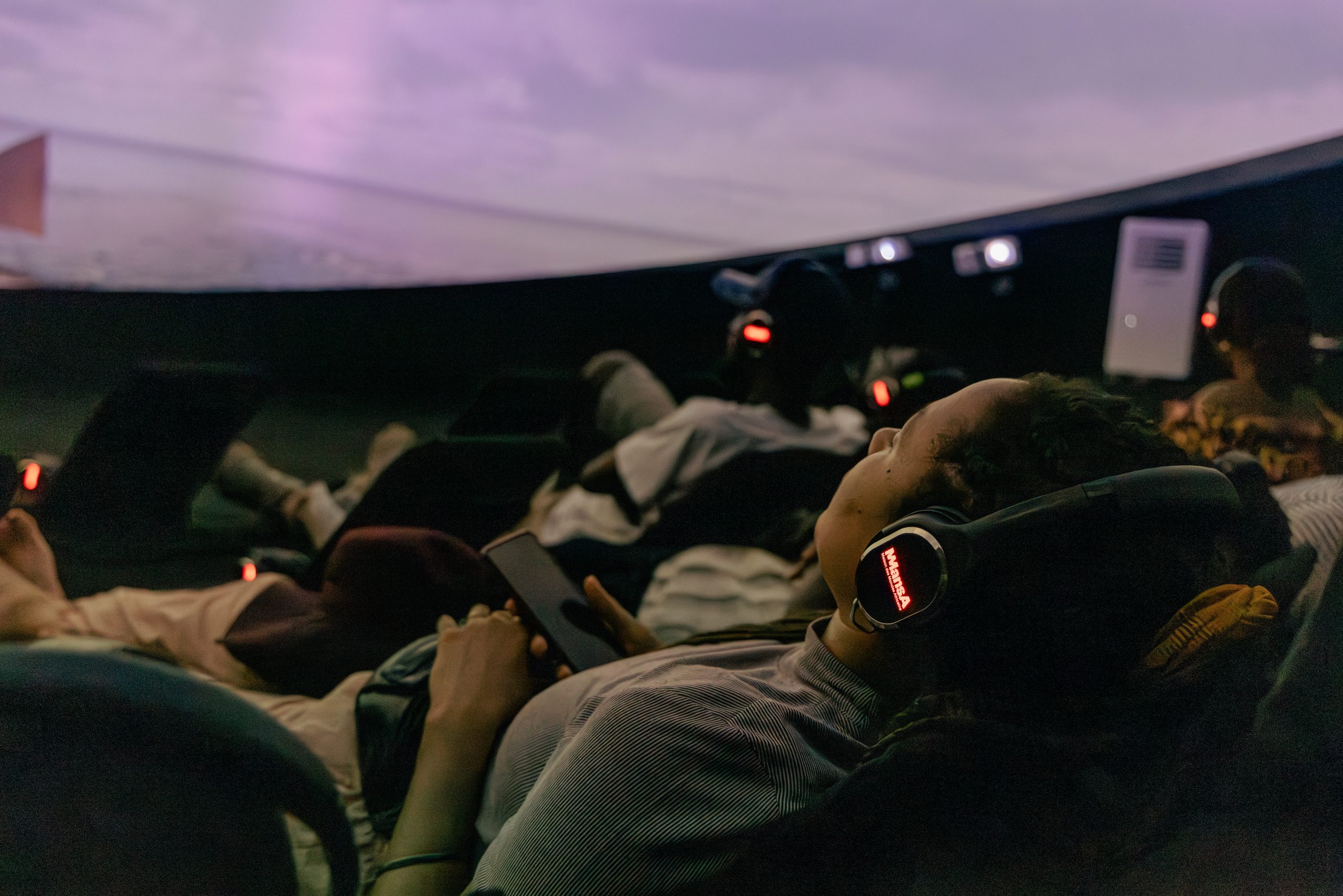
Her name means "courage" in Fongbe. Her name is Dotou, and she is embarking on a journey that history had made irreversible. Her odyssey is the beating heart of Kancícà, "the link," an immersive experience co-produced by MansA and Dream Feel Factory, where a poetic tale weaves together the living threads of the Black Atlantic.
By MansA
Published on 01/28/2026
Take your seat beneath the vaulted ceiling. All around you, the ocean rages, the drums resonate deep within your bones, and the shadows of the ancestors dance. You are no longer just a spectator: you are a passenger on Dotou’s ship, which set sail from Benin in search of Queen Na Agontimé, a historical figure from the Kingdom of Danxomè, who was deported to Brazil in the 18th century. Kancícà is not just a screening. It is an immersive and commemorative experience that allows you to feel the vibrant persistence of African spiritualities on both sides of the Atlantic Ocean.
The project is rooted in a well-documented historical context. The epic tale of Na Agontimé, wife of King Agonglo and Queen Mother of Danxomè, and the quest later undertaken by her son (the future King Ghézo) to find her, form the narrative framework that directors Laeïla Adjovi and Joséphine Derobe have adapted into an immersive story. Their ambition is clear: to honor the beauty and resilience of African and Afro-diasporic cultures, while celebrating the transnational space that is the Black Atlantic.
The heroine, Dotou, is a cartographer versed in vodun, trained in navigation and combat within an Agodjié regiment. Guided by her intimate knowledge of maps and spirits, she crosses the ocean accompanied by an unexpected companion: Segbo, a mischievous baby chameleon. A bold narrative choice that successfully blends historical gravity, mythological elements, and accessible poetry.
A total sensory immersion
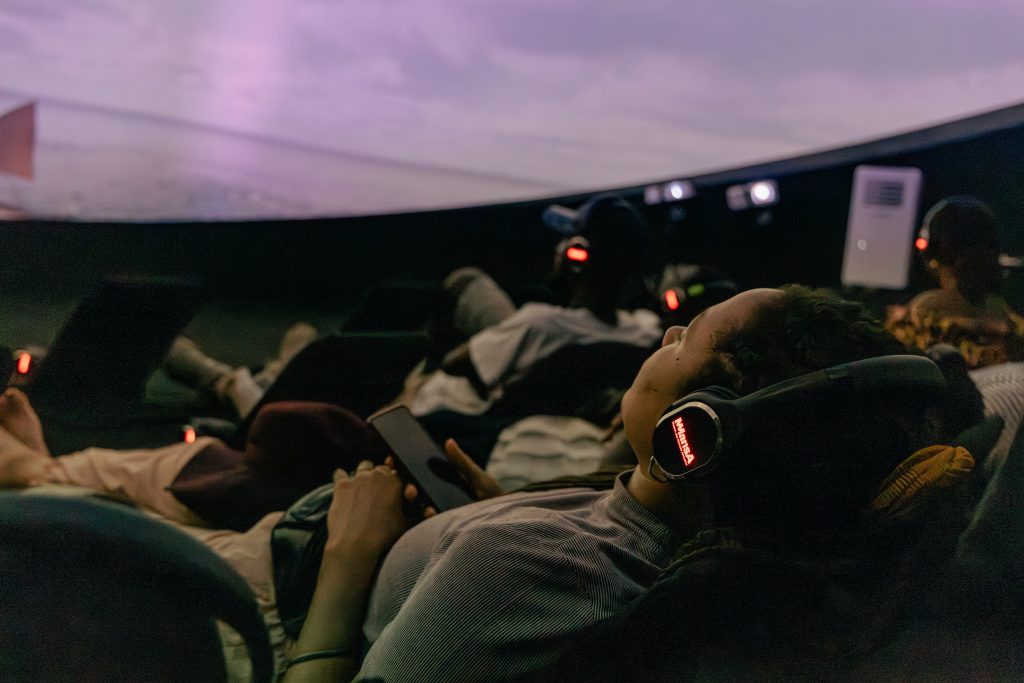
The power of Kancícà lies in the fusion of multiple artistic languages. The imagery evokes a dreamlike world that blends 3D animation, 2D shadow theater, and hand-drawn maps, projected onto a dome in 8K. The narrative unfolds around and above the audience, inviting them on a journey that is at once physical, spiritual, and symbolic.
The soundscape, composed by Brazilian musician and researcher Tiganá Santana, plays a central role. A specialist in African cosmologies and Candomblé, he weaves together a sonic tapestry of ritual chants in Fon and Yoruba, percussion, and natural and urban soundscapes recorded in Benin and Brazil. When listened to through headphones thanks to immersive sound spatialization, this installation transforms the dome into a true ritual space, where voices and rhythms become vessels of memory.
“It is through speech, music, and song that the key elements of African cultural heritage have been passed down from generation to generation in the Americas. This fact is reflected in our requirements for the sound design.” Laeïla Adjovi & Joséphine Derobe, directors
First crossings: from Brazil to Benin
Conceived from the outset as a transatlantic project, Kancícà was first presented in Brazil as part of the France–Brazil Season. This initial phase of the project’s presentation, notably at the Museu de Arte do Rio, brought the story to life in one of the places where African spiritualities were reborn and passed down in exile, engaging audiences who are the direct heirs to this history.
The work was then exhibited at the Maison de la Culture in Ouidah, Benin, one of the sites most steeped in the history of the transatlantic slave trade. A former port city on the Gulf of Guinea, Ouidah was a major hub of the slave trade, from which tens of thousands of captives were shipped to the Americas, particularly to Brazil.
By grounding itself in this landscape of memory, Kancícà takes on a unique dimension: the immersive experience resonates directly with the history it evokes. In Ouidah, the memory of Na Agontimé and the Kingdom of Danxomè remains deeply alive, embedded in the places, stories, and traditions. The dome thus becomes a space of passage and the circulation of memory, connecting the two shores of the Atlantic through a sensory, shared, and collective experience.
A production designed for travel
Behind the narrative’s poetic quality lies an innovative and socially conscious production model. Kancícà in Benin is the result of a partnership between MansA – Maison des Mondes Africains, Dream Feel Factory, and Benin’s Agency for the Development of Arts and Culture (ADAC), with support from the French Institute in Benin.
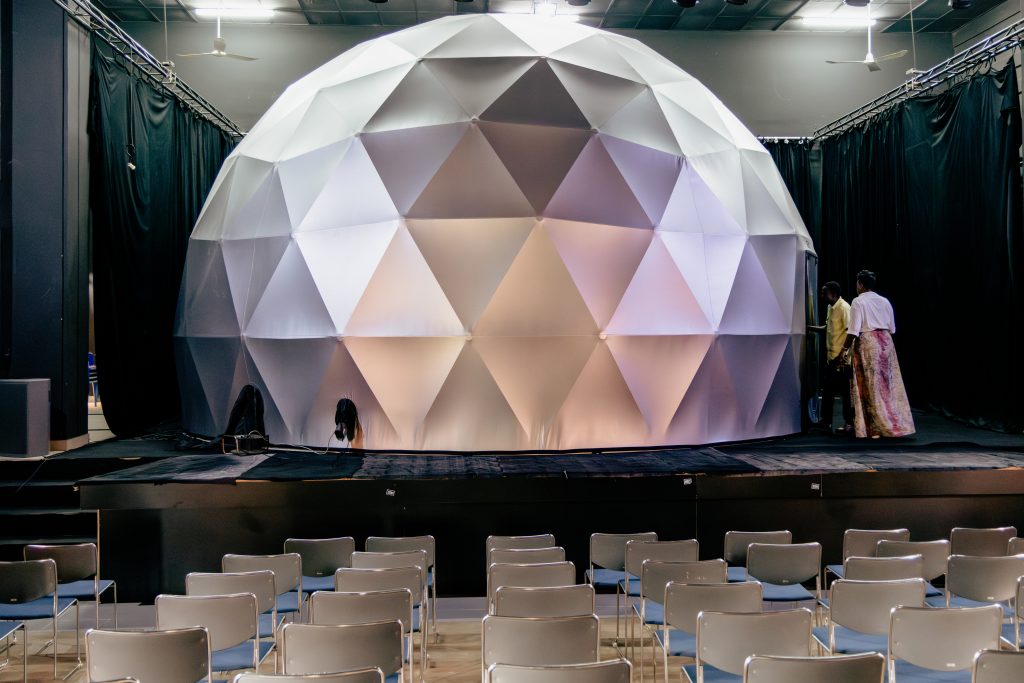
Designed to be portable and accessible, the entire setup—geodesic dome, projectors, and sound system—fits into four flight cases, making it easy to set up in a variety of settings, both in France and abroad. This logistical ingenuity reflects MansA’s commitment to sharing these stories of remembrance beyond the usual institutional venues.
With Kancícà, MansA reaffirms its role as a cultural laboratory: the dome becomes a resonance chamber for memories, a collective space where the bonds severed by the Transatlantic Slave Trade are symbolically reestablished for the duration of a shared experience. A powerful proposal that invites us to consider reparations not only as a historical endeavor, but also as an ability to collectively envision the bridges that history has sought to break.
See also | TheMansA's France-Brazil season
