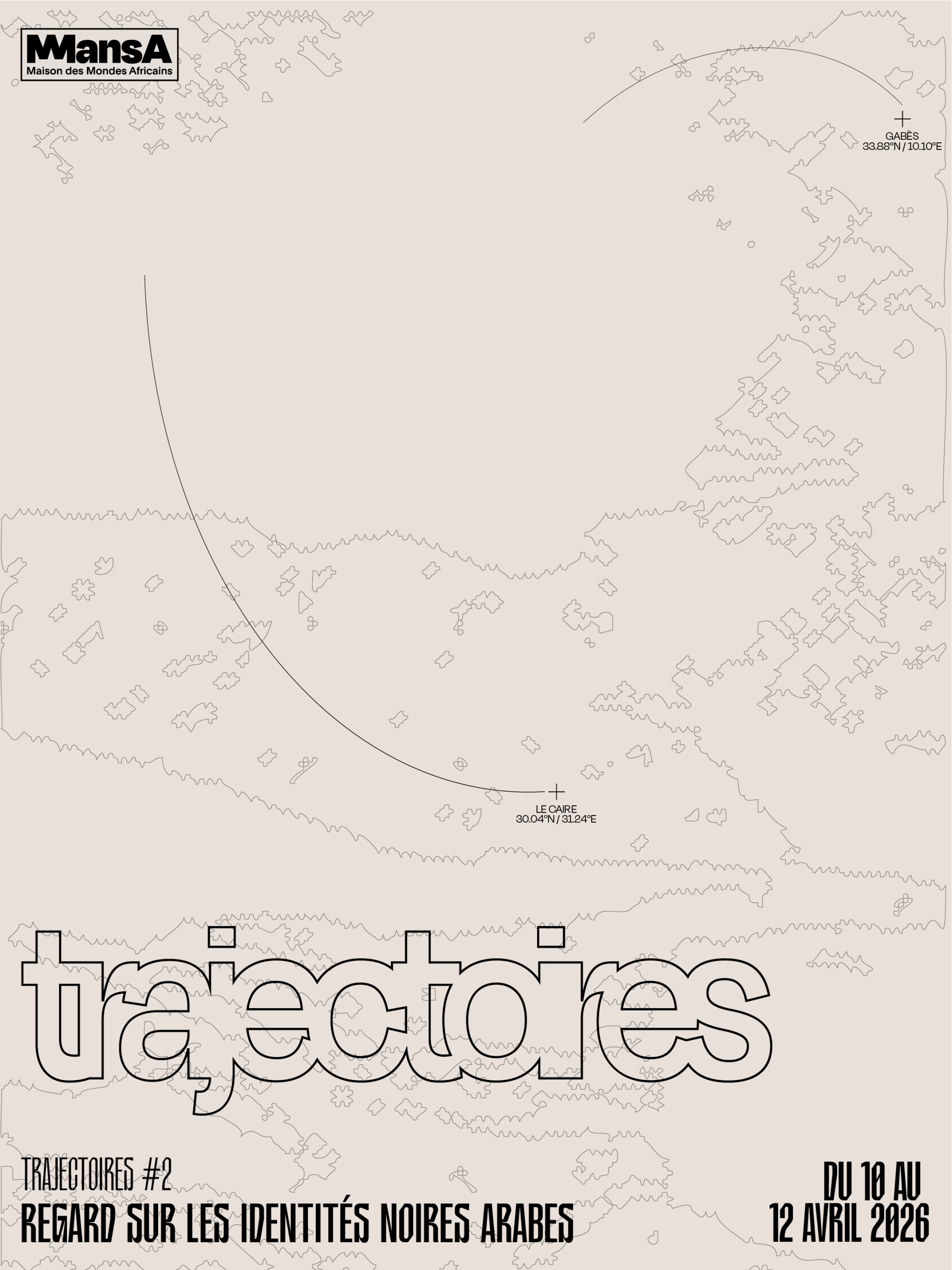
From April 10 to 12, 2026, Trajectoires will provide a space for encounters and creative expression to highlight Black Arab identities and Afro-diasporic narratives that are often overlooked. Through screenings, discussions, musical performances, and photographic installations, this new edition explores the history of Black communities in Egypt and Tunisia, as well as the convergence of the struggles they face within the societies in which they live.
Organized by MansA – Maison des Mondes Africains and developed in collaboration with legal scholar Nihal Osman, founder of SAWDA, this second edition explores memory, transmission, and the legacy of slavery, colonization, and national narratives. It also invites reflection on the role of individuality and the possibilities for self-determination within Black Arab identities, beyond labels and stigmatization.
On Friday, April 10, following a presentation of SAWDA’s program and approach, participants will have the opportunity to view a photographic installation by Palestinian artist Roba Alfarouna, which explores how language and the gaze contribute to mechanisms of differentiation, hierarchization, and control over bodies. The evening will continue with a musical performance by Sudanese singer Sulafa Elyas, whose acoustic repertoire, accompanied by the oud, draws inspiration from traditional Sudanese and Nubian rhythms.
On Saturday, April 11, following the screening of Nisreen Kaj’s short film *Yuqal* (“They Say”), which focuses on Hosh El Abeed—literally “the slaves’ quarter ”—a neighborhood over a century old located in Mina, in northern Lebanon—the discussion “Memory & Transmission” will address the legacy of slavery, colonization, and national narratives in the construction of identity. The discussion will feature Ines Mrad Dali, Shreya Parikh, Maha Abdelhamid, and M’hamed Oualdi.
This will be followed by a discussion titled “Identity: Between Self-Determination and Social Assignment,” focusing on the experiences of Black Afro-Arab women and the question of narrative legitimacy. The discussion will begin with a screening of the short films *Hanina* and *Homesick* by Yasmin Moll and will feature Fatma Emam, Roba Alfarouna, Yasmin Moll, Nihal Osman, and Amarillys Siassia.
On Sunday, April 12, the weekend will conclude with a Sudanese culinary experience (flat rate of €12, payable on site by credit card only) – view the menu here – followed by a bilingual reading of Afro-Arabic poems and myths for all ages by Myriam Rabah-Konaté.
Founded by Nihal Osman, SAWDA was born out of the realization that Black Arab identities are often rendered invisible, fragmented, or stigmatized. The organization’s mission is to create a space for expression, visibility, and creativity centered on these identities, by fostering artistic, cultural, and political dialogue between the diasporas of Black Arabic-speaking communities and the societies in which they live.
Nihal Osman is a lawyer specializing in international and public law and a humanitarian worker focused on migration issues at Europe’s borders. She also serves as an associate judge at the National Court of Asylum, appointed by the United Nations High Commissioner for Refugees (UNHCR). Navigating between France, Egypt, and her identity as a member of the Nubian community, her personal and professional journey has led her to question national narratives that exclude the individuality of Black communities in Arab countries, as well as narratives promoted by diasporas. Based in France, she works within a network spanning North Africa, the United States, and Europe, using culture to expand spaces for expression for Arab Black communities.
TRAJECTOIRES #2 – PROGRAM
Friday, April 10, 2026
7:00–10:00 p.m.: Opening Night
Starting at 7:00 p.m.: Opening of Roba Alfarouna’s photographic installation.
7:30–8:00 PM: Presentation of SAWDA’s program and approach.
8:30–9:30 PM: Musical performance by Sulafa Elyas.
Saturday, April 11, 2026
2:30–4:30 p.m.: Discussion – Memory & Transmission
The Legacy of Slavery, Colonization, and National Narratives in the Construction of Identity.
Screening of the short film *Yuqal* (“They Say”) by Nisreen Kaj.
Discussion with Ines Mrad Dali, Shreya Parikh, and Maha Abdelhamid.
Moderator: M’hamed Oualdi.
4:45–6:15 PM: Discussion – Identity: Between Self-Determination and Assignments
In what ways is the experience of Black Afro-Arab women unique? What is the legitimacy of the narrative?
Screening of the short films Hanina and Homesick by Yasmin Moll.
Discussion with Fatma Emam, Roba Alfarouna, Yasmin Moll, and Nihal Osman.
Moderator: Amarillys Siassia.
Sunday, April 12, 2026
12:00 PM–2:00 PM: Sudanese culinary experience (flat rate: €12 – payable on site by credit card only)
→ View the menu
2:30 PM–4:00 PM: Bilingual reading of Afro-Arabic poems and myths for all ages by Myriam Rabah-Konaté.
SPEAKERS
Ines Mrad Dali – PhD in Social Anthropology (EHESS) and professor of contemporary history at the University of Manouba. Her research focuses on slavery and post-slavery in Tunisia and the Arab-Muslim world.
Shreya Parikh – Research fellow at CERI (Sciences Po) and Ph.D. candidate in sociology (Sciences Po / University of North Carolina). Her research focuses on race, migration, and processes of racialization in North Africa, particularly in Tunisia.
Maha Abdelhamid – A Tunisian researcher affiliated with CAREP Paris and a Ph.D. in social geography. Her work focuses on minorities, socio-spatial dynamics, and the experiences of Black women in North Africa and the Middle East.
Fatma Emam – An Egyptian feminist researcher and activist dedicated to issues of social justice, racism, and marginalization, particularly as they affect Nubian communities.
Roba Alfarouna – A Palestinian artist and photographer and graduate of the Bezalel Academy of Art and Design, whose work explores the relationships between language, the gaze, and power structures.
Yasmin Moll – Cultural anthropologist and professor at the University of Michigan. Her research focuses on media, religion, politics, and race in the Middle East.
Nihal Osman – A researcher and speaker whose work explores Afro-Arab identities, diasporas, and issues of representation.
M’hamed Oualdi – Professor in the Department of History at the European University Institute in Florence. After teaching at Sciences Po Paris, he is currently organizing the exhibition *Slaves in the Mediterranean (13th–18th Centuries)*, which will be on view at the IMA from March 31 to July 19, 2026.
Amarillys Siassia – History and Geography teacher in Aulnay-sous-Bois and a doctoral student in contemporary history at the Sirice Research Unit. Her research focuses on aid policy under the Vichy regime. She has co-led training sessions on political anti-racism, published articles, and participated in several academic events in France.
Sulafa Elyas – A Sudanese singer based in Paris, performing an acoustic repertoire inspired by Sudanese and Nubian musical traditions, accompanied by the oud.
Nisreen Kaj – Director of the short film *Yuqal* (“They Say”), which focuses on the Hosh El Abeed neighborhood in Mina, Lebanon.
Myriam Rabah-Konaté – Author, audio documentary filmmaker, and dancer, whose work explores Afro-diasporic memories and narratives.
