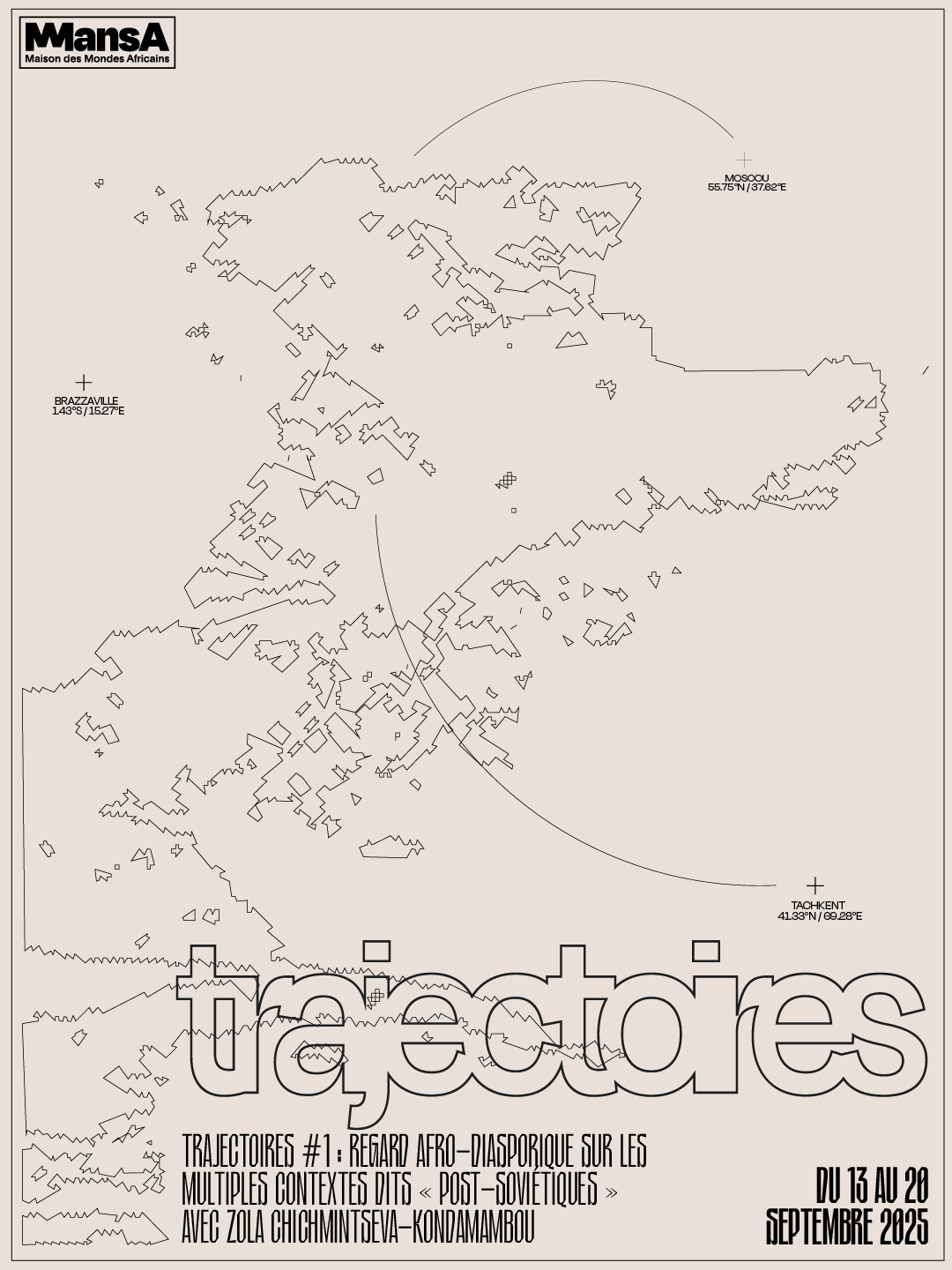
From December 13 to 20, 2025, MansA is launching Trajectoires, a new series dedicated to Afro-diasporic narratives in geographies that are too often overlooked. For this first edition, curator Zola Chichmintseva-Kondamambou offers a week of screenings, discussions, and exhibitions focusing on African and Afro-descendant experiences within political and cultural contexts marked by Soviet domination and occupation.
Trajectoires was born out of a necessity: to make visible the movements and presence of the African diaspora in spaces where they have been systematically erased. This program invites emerging and established cultural actors to examine African heritage in geographies and time periods that have long neglected these narratives. Through debates, amplified memories, and new forms of encounter, Trajectories resonates with the plurality and vitality of contemporary Afro-descendant experiences.
Between archives, cinema, contemporary art, and oral history
To inaugurate this cycle, Zola Chichmintseva-Kondamambou has put together a program that spans archives, research, cinema, contemporary art, and oral history. At the heart of the project is the exhibition Ode to Elders, a traveling investigation combining spiritual reflection, living history, diasporic memory, and criticism of narratives inherited from Soviet domination.
The day on September 13 will begin with a presentation of the program, followed by the screening of two short films by Souleymane Cissé, made during his studies at the S. A. Gerasimov National Institute of Cinematography, known as “VGIK,” in Moscow. L’Aspirant (1968) follows a young Malian man attempting to reconcile traditional Bambara medicine with his Soviet training. Sources d’inspiration (1966) documents the work of painter Mamadou Somé Coulibaly, the first African student at the Moscow Academy of Fine Arts, who would go on to help establish the art program in Bamako.
This screening will be followed by a discussion on the topic “Cinema and the Experiences of African Students in Soviet Contexts” with Sasha Artamonova, a doctoral candidate in African American and African Diaspora modern and contemporary art history in the Department of Art History at Northwestern University in the United States and at the École des Hautes Études en Sciences Sociales in Paris.
In the late afternoon, a panel discussion will bring together artists Louisa Babari, Azadbek Bekchanov, and Grace La-Joly to explore “racial dynamics and anti-racism in so-called post-Soviet spaces.” Louisa Babari will discuss her parents’ experiences—a Russian-Ossetian mother born in Uzbekistan and an Algerian father—in the USSR. Grace La-Joly will share her experiences studying at art schools in Ukraine and Latvia, navigating the tension between artistic “safe spaces” and the complex daily reality faced by a young woman of Ukrainian and Congolese descent. Azadbek Bekchanov will offer an analysis of the colonial debates that shaped the Bolshevik Revolution and their contemporary echoes.
Revealing the invisible, reactivating traces
The evening will continue with the public opening of Ode aux doyen·nes. The exhibition—which will be held at MansA until December 20—weaves together several layers: an altar designed in situ by Shivay La Multiple to honor the invisible, a reflection by Grace La-Joly on identities since exile and matter in motion, the archives of a bookstore imagined by Louisa Babari, and new narratives proposed by DAVRA around the Tashkent International Film Festival of African and Asian Cinema.
On December 20, the last day of the exhibition, two guided tours will allow visitors to explore the exhibition alongside Zola Chichmintseva-Kondamambou, who will revisit the issues raised by this sensitive, localized, and non-exhaustive mapping of Afro-diasporic presences in post-socialist contexts.
Zola Chichmintseva-Kondamambou is a curator and cultural mediator working at the intersection of Afro-diasporic cultures and so-called post-socialist and "post-Soviet" spaces, dissecting the (de)colonial gaze on cultures, memories, and languages. These transdisciplinary approaches and projects take the form of debates and exchanges of ideas, archiving of oral histories, and exhibitions. Zola's work draws on colonial histories, their dissemination, and their implications in order to question our contemporary political and cultural realities.
A graduate of Sorbonne Nouvelle-Paris 3 and Sciences Po Strasbourg, Zola has collaborated with Manifesta, the European Nomadic Biennial, the Fondation pour la mémoire de l’esclavage (Foundation for the Memory of Slavery), the Gaîté Lyrique, and the Maison de la Culture d’Amiens in conjunction with the Beyond the Post-Soviet collective and the Institut français.
Saturday, December 13
4:00 p.m. – 4:30 p.m.
Introduction to programming by Zola Chichmintseva-Kondamambou
4:30 p.m. – 5 p.m.
Screening of L’Aspirant (1968, 13 min) and Sources d’inspiration (1966) by Souleymane Cissé
5:00 p.m. – 6:15 p.m.
Discussion with Sasha Artamonova, doctoral student in art history (Northwestern University / EHESS)
6:30 p.m. – 7:30 p.m.
Round table discussion with Louisa Babari, Azadbek Bekchanov, and Grâce La-Joly. Moderator: Zola Chichmintseva-Kondamambou
7:30 p.m. – 10 p.m.
Public opening of the exhibition Ode aux doyen·nes (Ode to the Elders)
December 14 to 20
Exhibition Ode to the Elders
Accessible during the hours indicated at the ticket office.
Featuring works by:
Shivay La Multiple, Grace La-Joly, Louisa Babari, and DAVRA
Saturday, December 20
2:00 p.m. – 3:00 p.m. then 4:00 p.m. – 5:00 p.m.
Guided tour with Zola Chichmintseva-Kondamambou
Closure
