At the second Research Breakfast, held on March 5, 2026, Alexandra V. D. Pierre, a Ph.D. in geography and climate change, will offer insights into the colonial legacies that continue to shape marine conservation policies in the French- and Spanish-speaking Caribbean. Drawing on examples from Haiti, Cuba, and Guadeloupe, her presentation highlights local dynamics—artisanal fishing, ecotourism, and women’s entrepreneurship—that combine traditional knowledge with socio-ecological innovations to envision more inclusive forms of biodiversity protection.
By Alexandra V. D. Pierre
Published on March 10, 2026
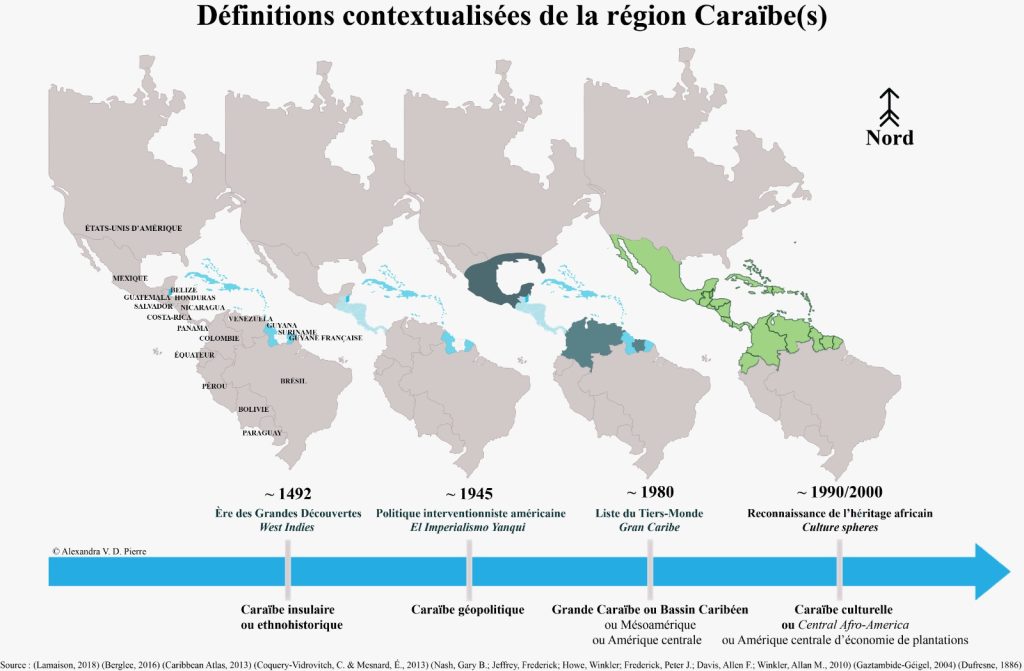
The Caribbean, a region of “variable geometry” (Cruse, 2014), embodies competing representations: the insular Caribbean of the Age of Discovery; the geopolitical Caribbean marked by U.S. interventionism; the Greater Caribbean of Third Worldism with its contrasting economies; the cultural Caribbean of the global plantation economy (Ref. Figure 1). Thus, the designation of Marine Protected Areas (MPAs) often replicates a logic of themaritime Plantationocene: an exogenous power that determines the use of a territory or “merritory” ” (Parrain, 2010) through minimal consultation with local populations, to the detriment of local knowledge. Their designation as national parks, modeled on the extraterritorial Yellowstone model (federal control, expulsion of Native Americans, wilderness defined by Western science), perpetuates this top-down vision.
This colonial fragmentation is threefold: institutional (overlapping jurisdictions), spatial (fragmented zoning), and epistemic (marginalization of local knowledge). It manifests in three distinct configurations in the French- and Spanish-speaking Caribbean. Haiti (Île-à-Vache) embodies institutional failure offset by de facto self-governance with a “paper park” and self-generated local rules (Pierre & Desse, 2022)—substitute communitarianism. Cuba (Ciénaga de Zapata) illustrates state centralism where populations are functionally integrated into a national system of protected areas—subordinate communitarianism. Guadeloupe falls under a form of institutional centralism integrated into French and European frameworks, where local populations act as proponents (Grenelle de la Mer, charter) within a standardized framework—affirmative communitarianism.
Faced with these circumstances, communities have demonstrated socio-ecological creativity. In the case of Haiti’s Île-à-Vache ( ), a “globalization of the poor” (Choplin & Pliez, 2018) has transformed the rural island into a supply hub for the capital, organized by a sorority of female merchants who control the fishing industry. In Nan Kokoye, a form of self-governance among fishermen aligned with Ostrom’s principles has been observed: clear boundaries, citizen oversight, enforced sanctions, and local mediation. The tourism offering, whether the three modern hotels or the bed-and-breakfasts (Chez Jérôme Genest, the Frères de Sainte Thérèse de l’Enfant Jésus guesthouse), remains constrained, however, by access to energy. In Cuba, regulatory relaxation has fostered self-employment in the municipalities of Matanzas and Mayabeque: casas particulares, local operators, and family-run agroecological farms led by women (El patio de María, Los Pintines). In Guadeloupe, the “Esprit Parc national” label and the European Regional Development Fund support eco-tourism both outside and within national parks, combining Creole traditions (Îlot Palmier, Laliwondaj, Paradise Kafé) with low-carbon excursions (Mangrov’EcoTour, TamTam Pagaie) in an outermost region of the European Union.
Decolonizing marine conservation in the French- and Spanish-speaking Caribbean rests on three pillars of justice: (1) Epistemic—the creolization of science, the integration of local knowledge, and the recognition of vernacular languages; (2) Territorial—the devolution of power to local authorities and the repatriation of maritime domains in the face of U.S. blue imperialism; (3) Social – inclusive local development, visibility of women in coastal economies, promotion of local know-how without commercial standardization. A model of co-management and co-governance of these MPAs would pursue two inseparable objectives: Understanding and Serving biodiversity (ecosystems, protection) and humans (traditions, local/sustainable development). In short, decolonization means protecting alongside local communities, respecting the region’s diversality (Glissant, 2000), and listening to the situated knowledge of fishermen, merchants, mangrove guardians, and local authorities. Ecological justice will only come about alongside epistemic, territorial, and social justice.
Bibliography
Choplin, A., & Pliez, O. (2018). The Globalization of the Poor: Far from Wall Street and Davos. Éditions du Seuil.
Cruse, R. (2014). A Popular Geography of the Caribbean. Mémoire d’encrier, 590 pp.
Glissant, É. (2000). Globality, diversity, unpredictability: concepts for acting in the World-Chaos. Les Périphériques vous parlent, (14), 18–29.
Parrain, C. (2010). Territorialization of the high seas: The contribution of sailing in the Atlantic Ocean [Doctoral dissertation, University of La Rochelle]. https://theses.hal.science/tel-00713524/document
Pierre, A. V. D., Desse, M. (June 2022), “Adapting Without Government Intervention in Marine Protected Areas on Paper.” Poster presented at the conference “Rising Sea Levels: From Natural Areas to Coastal Regions—What Adaptation Strategies?” La Cité des Congrès, Nantes, France. https://hal.archives-ouvertes.fr/hal-03708957/document
¶ Alexandra V. D. Pierre holds a Ph.D. in Geography and Climate Change from the University of Nantes (France) and Quisqueya University (Haiti). A former postdoctoral researcher at the University of Le Mans (ESO Laboratory – CNRS), she now works as an independent researcher and international consultant. She assists Haiti in accessing the “Loss and Damage” Fund related to climate change as a consultant for the United Nations Environment Programme (UNEP). In 2025, she was selected for the “La Science Taille XX Elles” program (CNRS / Association Femmes & Sciences) and recognized as one of the 24 women scientists in the Pays de la Loire region.
