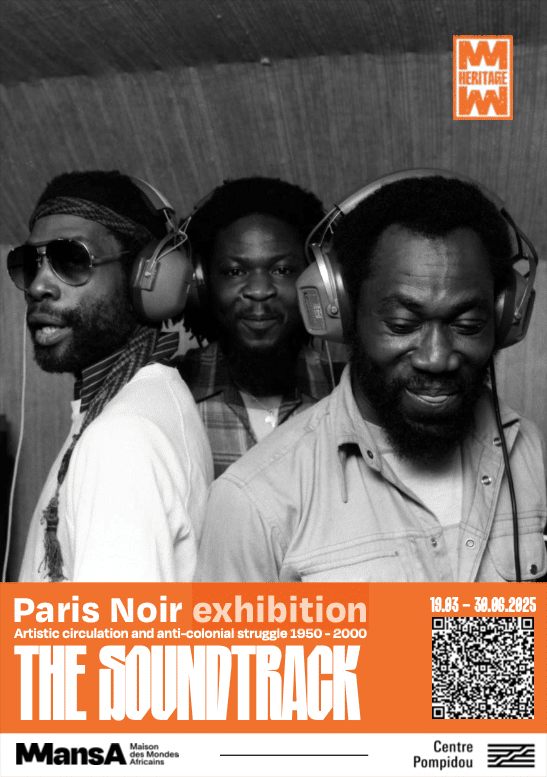
MansA has produced the official soundtrack for the exhibition Paris Noir - Circulations artistiques et luttes anticoloniales, 1950 - 2000 at the Centre Pompidou, paying tribute to the musical vibrations that shaped the black Parisian scene from 1950 to 2000.
To complement and enhance the experience of the “Paris Noir” exhibition at the Centre Pompidou, MansA has created a series of four themed playlists, accompanied by a booklet, to explore the full richness and diversity of Black music in Paris between 1950 and 2000. From jazz to pop, blues to zouk, and everything in between—including gwoka, funk, hip-hop, soul, salsa, mbalax, rumba, electro, and reggae—nearly all the major figures in Black music have passed through Paris—whether briefly or for longer stays, but rarely to settle there permanently.
Paris emerges as a vibrant crossroads, a meeting place where musical traditions intersect, intertwine and constantly reinvent themselves.
Each playlist lasts three hours and invites exploration: the first is cross-genre and cross-era, while the next three focus on artists from the Caribbean, Africa and the United States.
Volume 1 - Musardise in Paris noir
A musical journey through Black Paris, featuring both iconic tracks and hidden gems.
This anthology is a musical journey through Black Paris, featuring both iconic tracks and hidden gems. From John Lee Hooker's first concert in Paris in 1962 to the African music boom of the 1980s (Toure Kunda, Mory Kante, etc.), from the West Indian cabarets of the 1950s echoing with the voices of Moune de Rivel to the African-American jazzmen who made the capital vibrate (Art Blakey, Quincy Jones, Miles Davis, etc.), from the echoes of free jazz in the 1970s (Archie Shepp, Art Ensemble of Chicago) to the sparks of emerging hip-hop, Paris is a constantly evolving scene.
In 1962, John Lee Hooker electrified the town. In 1978, Grace Jones made the Palace her home with La Vie en Rose. In 1988, Kassav set the Zenith ablaze with Le Grand Méchant Zouk, celebrated by Miles Davis and Youssou N'Dour. Manu Dibango, a tireless ferryman, weaves links between Africa, the West Indies and funk, working with African musicians such as Ernesto Djedjé and Franklin Boukaka, or West Indian musicians like Jacob Desvarieux, Jean-Claude Naimro and Claude Vamur, or with the Bisso na bisso collective, which blends rap and African music. At the same time, Public Enemy set the Globo on fire, and Lucien Revolucien made French hip-hop resonate on Radio Nova, even inspiring A Tribe Called Quest.
So many stories and melodies that have shaped the soundtrack of Parisian nights. It's up to each and every one of us to rediscover a memory or let ourselves be surprised.
Volume 2 - Africa in Paris
From the first recordings of Les Ballets africains in Paris
Since the post-war years, Paris has been a crossroads for the reinvention of African music.
In legendary cabarets and concert halls, generations of artists from the continent and the diaspora have woven a vibrant soundtrack, between roots and modernity. In 1952, Keïta Fodéba's Ballets Africains set the Théâtre de l'Étoile alight. Later, Tabu Ley Rochereau became the first African to play at the Olympia, while the Hippodrome de Paris hosted a historic concert by Fela Kuti.
Starting in 1978, the Africa Fête festival, initiated by Mamadou Konté, celebrated this energy and brought together Toure Kunda, Salif Keita, Youssou N’Dour, and Kassav. In 1989, Africolor took over, promoting West African sounds. The 1980s marked a musical explosion: Emma by Toure Kunda, Yéké Yéké by Mory Kanté, and Brigadier Sabari by Alpha Blondy resonated far beyond Paris. Meanwhile, soukouss music had Afro-descendant communities dancing with Papa Wemba, Zaiko Langa Langa, and Koffi Olomidé.
Paris is also a breeding ground for daring experimentation. Boni Bikaye and Hector Zazou fused afrobeat and new wave, Black Mic Mac popularized African club grooves, and Manu Dibango built bridges between continents.
From the commitment of Miriam Makeba to the energy of Amadou & Mariam, this selection celebrates the incredible diversity of a city where African music has never stopped reinventing itself.
Volume 3 - Paris Caribbean
An essential contribution to Parisian music
West Indian musicians have always played in Paris.
In the 1950s, the capital was alive with West Indian clubs: La Boule Blanche, L'Élan Noir, Le Caraïbe, La Cabane Cubaine, La Canne à Sucre and Bal Blomet (then known as Bal Nègre). They gradually gave way to nightclubs like Le Mambo, Rex Club and Le Galion in the suburbs. Radio stations such as Radio Nova, Africa N°1 and Média Tropical spread Caribbean culture.
Paris welcomes all the big names in West Indian music. Artists like Eugène Mona and Max Cilla, deeply rooted in their traditions, give remarkable concerts there, like Mona at La Mutualité, described by Le Monde as a "star of the black world."
From the beginning, the beguine became popular with Eugène Delouche, Moune de Rivel, Ernest Léardée, and Gérard La Viny. In the 1970s, gwoka was reborn (Mona, Ti Céleste, Cilla), playing for a growing West Indian community with the creation of Bumidom (Bureau for the development of migrations concerning the overseas departments) in 1963.
Latin American influences (salsa, merengue, boogaloo) also marked the music scene, led by Henri Guedon, Marius Cultier, Les Vikings, and La Perfecta. Kassav then revolutionized the West Indian sound by incorporating African and funk sounds, creating zouk, which would achieve global success. In 2000, they organized the Grand Méchant Zouk at the Zénith de Paris.
Finally, jazzmen such as Patrice Caratini, Richard Raux, and Louis Xavier enrich the Parisian music scene.
This non-exhaustive selection bears witness to the essential contribution made by West Indian artists to Parisian music.
Volume 4 - Paris Blues
African-Americans swinging in Paris
This selection illustrates the presence of African-American musicians in Paris between 1950 and 2000. Almost all the big names in jazz, blues, soul and funk played here, some leaving an indelible mark.
Parisian labels such as BYG (free jazz), Black & Blue (blues, jazz), Barclay (jazz) and Saravah (Brazilian jazz, free jazz) recorded these artists, testifying to this effervescence.
By 1945, Saint-Germain-des-Prés had become a jazz mecca, welcoming Quincy Jones, Miles Davis, Bud Powell, Erroll Garner and Charlie Parker to legendary clubs such as Club Saint-Germain, Le Tabou, La Caveau du Vieux Colombier and Caveau de la Huchette. The Jazz in Paris collection documents this era perfectly.
The selection crosses genres: soul with Ray Charles, Nancy Holloway(T'en va pas comme ça), Terry Callier and Nina Simone(Ne me quitte pas); blues with Luther Allison, Roy Gaines, Memphis Slim, T-Bone Walker; free jazz with Sun Ra, Dewey Redman, Don Cherry and the Art Ensemble of Chicago(Je suis un sauvage, sung by Alfred Panou, precursor of slam) ; and, of course, jazz with Miles Davis(Ascenseur pour l'échafaud), Quincy Jones, Erroll Garner, Sam Price, Mary Lou Williams, Sidney Bechet (who sold more records than Édith Piaf!), Count Basie, Louis Armstrong(La Vie en rose), Don Byas(Laura), Art Blakey(Les Liaisons dangereuses), Ahmad Jamal (legendary 1971 concert) and even the velvet-voiced crooner Henri Salvador.
All these titles form a journey through 50 years of Parisian jazz, which is not intended to be exhaustive, but rather objective, with a mix of classics, rarities and curiosities.
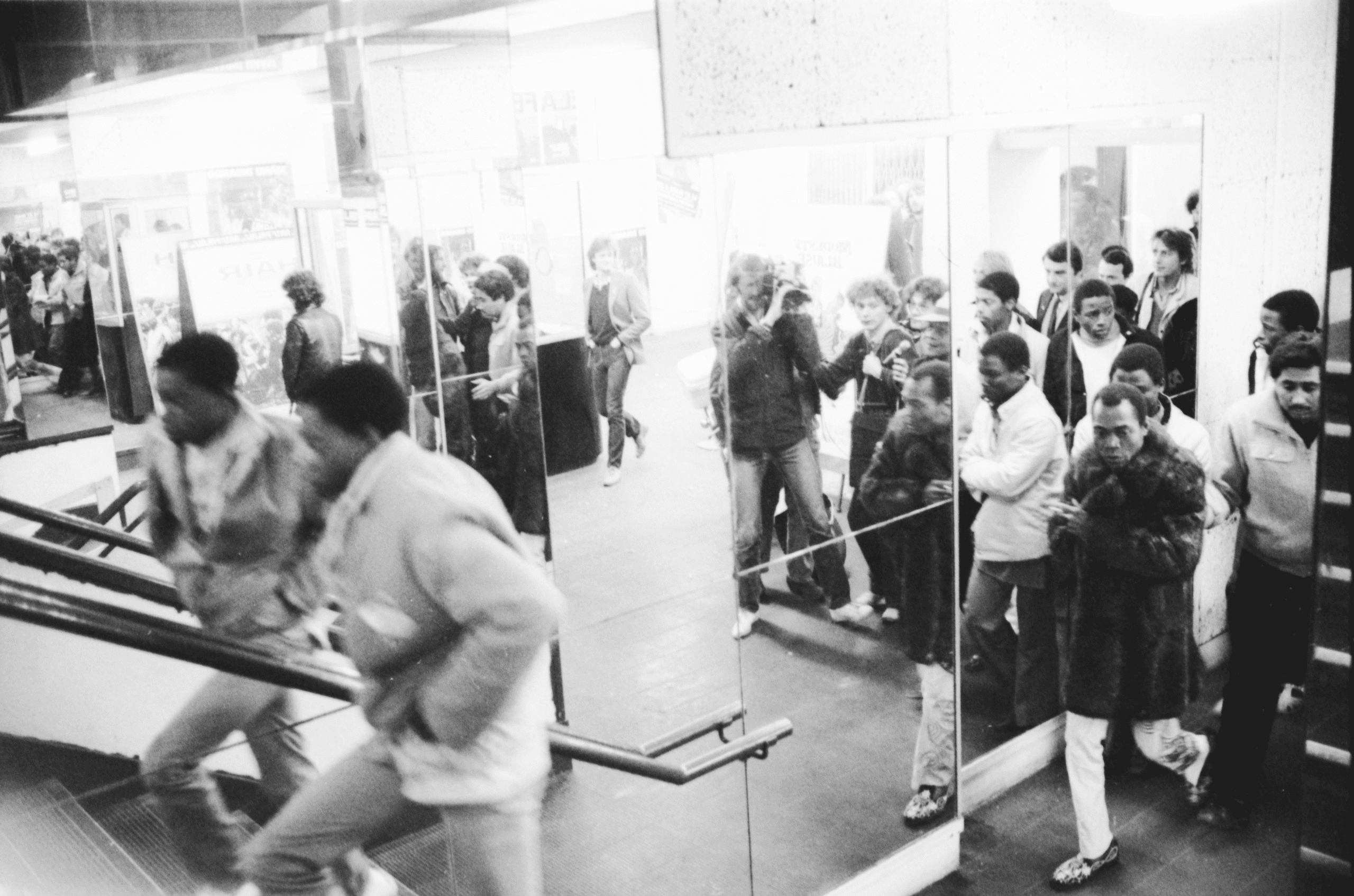
Cover photo: Interview with Fela Kuti in 1981 © Bill Akwa Bétoté. All rights reserved
Find out more:
